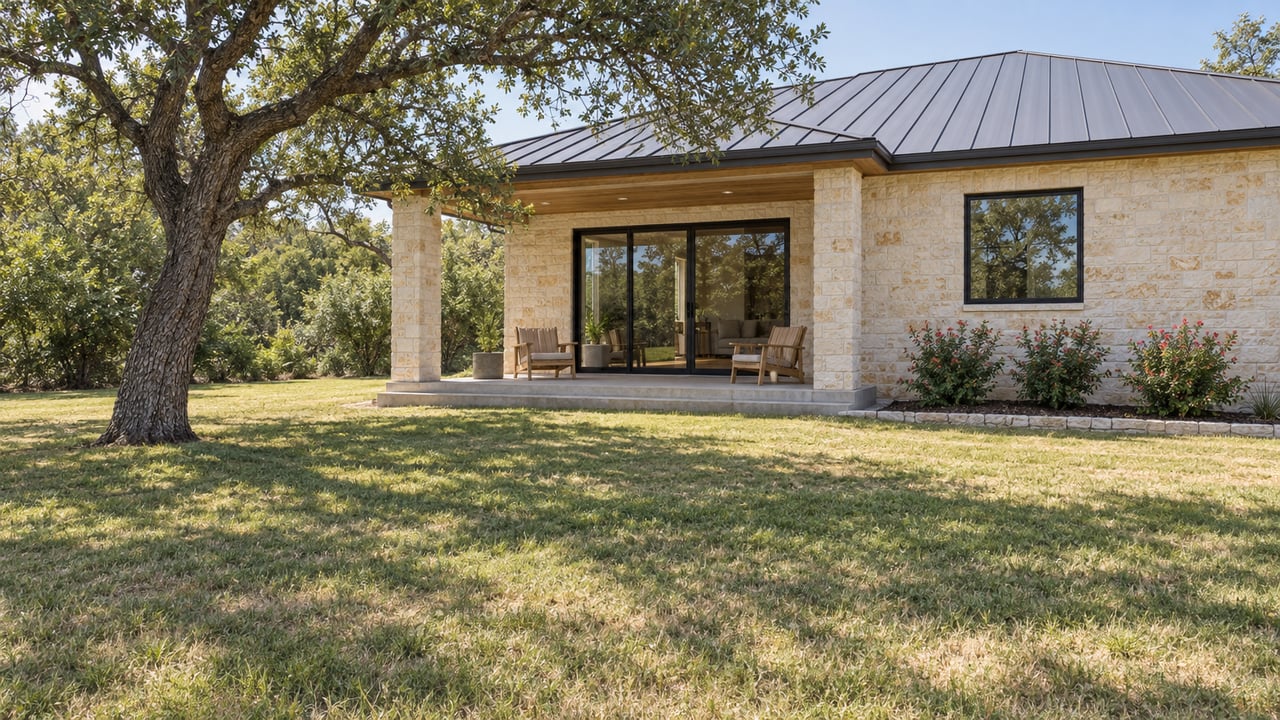
For years a single mobile home sat on a lot of about 16,000 square feet in 78745, the South Austin ZIP code that includes South Manchaca. By late 2024 the same lot held three new houses of about 1,700 square feet each. Carr Residential promoted the project at 1900 Keilbar Lane as the first under Austin's HOME Phase 1 rules to reach the market. In December 2024 each house was offered at $599,000. Cody Carr said the plan was for two units until HOME passed, and then it became three.
Carr told KVUE that under the old rules he might have had to build a "$700,000-plus home" on that land. Under HOME he could build "something in the $500,000 range." The quote is usually read as a story about cheaper housing. For someone comparing an older house on a large South Manchaca lot with a new infill home a few streets away, it also says something about what a large lot can now hold.
The headline discount is mostly square footage
In April 2026, Unlock MLS and the Austin Board of Realtors published the first real sales comparison. It covers 57 HOME new-construction units and 115 traditional single-family new builds that were built and closed inside Austin during 2025.
| 2025 closed new construction, City of Austin | HOME units | Traditional single-family |
|---|---|---|
| Median sales price | $750,000 | $1,580,000 |
| Median size | 1,693 sq. ft. | 3,029 sq. ft. |
| Median close price per sq. ft. | $477 | $522 |
| Median bedrooms | 3 | 4 |
| Median parent lot size | 6,708 sq. ft. | 8,276 sq. ft. |
| Discount from list price | 6.1% | 10.6% |
| Median days on market | 32 | 37 |
The report leads with the 53% price gap. Per square foot, though, the gap is about 9%. A median HOME unit has about 56% of the floor area of a median traditional new build and sells at nearly the same rate per foot. The buyer is mostly buying a smaller new house at close to the going sale price per foot for new construction.
The lot-size row matters for the rest of this post. For HOME projects, the report measures the whole property the units were built on. That median was 6,708 square feet, and the report reads it as a sign that HOME construction is concentrated on smaller infill lots near the urban core. The Keilbar lot was more than twice that size, which is why three family-sized houses fit on it with room left for parking and yards. Carr made that point about the project.
Why smaller houses sold faster and closer to asking
If HOME units cost almost as much per foot, why did they sell quicker and with smaller discounts? The report does not answer that directly, but the price bands they sell in are the clearest difference. Of the 57 HOME sales, 36 closed between $500,000 and $899,999. Only 12 of the 115 traditional new builds landed in that range, and 79 of them closed at $1.2 million or more. The report also found that 14 of the 16 traditional new builds under $500,000 were in one master-planned community outside the urban core. Without those, only 2.0% of traditional new builds sold below $500,000.
In 2025, HOME projects supplied most of the new construction that closed in Austin between $500,000 and $899,999. With few traditional new builds at those prices, HOME units closed in a median 32 days at a 6.1% discount, while larger new homes took 37 days and gave up 10.6%. The report places most 2025 HOME sales in a band running from South Congress through East Austin into north-central neighborhoods. It does not count sales by ZIP, so it cannot say how many were in 78745.
What this means for a large lot
Put the two findings together. HOME units sold at close to the per-foot price of traditional new builds, and they sold in a price band where few traditional new builds closed. A HOME project produces several moderately priced sales in place of one expensive sale competing in a crowded top tier, where 79 of the 115 traditional new builds closed at $1.2 million or more. Keilbar Lane is the local example: one large lot, one mobile home, and then three houses offered at $599,000 each.
Neither the report nor the City puts a dollar figure on what HOME adds to a lot's value. The rules still give an older house on a big 78745 lot an option it did not have before HOME. It can stay one home, or it can become two or three homes that sell into the price band where new inventory is scarcest. Two buyers can look at the same 1970s ranch house and value it differently because one of them is pricing the lot under HOME and the other is pricing only the house.
City data shows how quickly that option is being used. As of the City's September 8, 2026 dashboard update, 714 HOME Phase 1 applications had been approved citywide, covering 1,421 new units. In the first year, through February 4, 2025, the numbers were 236 approved applications and 436 units. No public source breaks those approvals out for 78745.
What the option looks like on a specific lot
The City of Austin's HOME page lists the current rules. Phase 1 allows up to three units on SF-1, SF-2, and SF-3 lots. Phase 2 allows one small-lot house on a lot of 1,800 to under 5,750 square feet. For a buyer evaluating a large South Manchaca parcel, four details shape what the option is worth:
- Adding units on the existing lot has proven easier than splitting it. Phase 2 small lots usually require a subdivision. In its first year, the City recorded two subdivision applications proposing five small lots, and it attributed the low uptake partly to how complicated subdivision is. Keilbar went the Phase 1 route, with three units on one existing lot.
- When the lot was created affects drainage review. Under the Infill Ordinance, which took effect in 2025, a project of four units or fewer on an infill lot created before June 16, 2025 does not need drainage review. Lots approved later with a grading plan have to follow that plan.
- Keeping the existing house is now worth more. On April 24, 2025, City Council expanded the Preservation Bonus. When the original home is preserved, the two added units can now total 0.65 FAR or 4,350 square feet, up from 0.55 FAR or 3,200 square feet, with no increase in allowed impervious cover. The change took effect May 5, 2025. On a large lot with a solid older house, the larger allowance applies only if the existing home stays.
- State law does not change the math for an existing lot. Texas SB 15, effective September 1, 2025, covers unplatted tracts of five acres or more that are being platted. It does not affect an established, already-platted 78745 lot.
The Preservation Bonus has seen limited use so far. The City's dashboard counts eight uses citywide and gives no neighborhood breakdown.
Reading the current market with this in mind
In August 2026, the median home price in the City of Austin was $560,000, down 4.3% from a year earlier. Sales fell 10.3% to 844, and homes sold at an average of 93.3% of list price, up from 91.6% in August 2025, according to KVUE's coverage of the Unlock MLS report. A softer citywide median makes larger older lots look more affordable. It does not change what HOME allows on them.
For a South Manchaca buyer, that means two separate calculations. For a new HOME unit, compare its price per square foot with the $477 median for 2025 HOME sales. Its total price is lower because the house is smaller, not because each foot is cheaper. For an older house on a large lot, the price covers both the house and the right to add up to two more units. Before deciding a listing is expensive or a bargain, check the lot's zoning, whether it was platted before June 16, 2025, and how much impervious cover is left.
FAQ
Are HOME-built homes a discount version of new construction? Per square foot, not really. In 2025 they closed at a median $477 per square foot, compared with $522 for traditional new builds. Most of the price difference comes from the houses being smaller.
Is there a count of HOME projects in South Manchaca or 78745? Not in public City reporting. The City's approval figures are citywide, and the Unlock MLS sales analysis maps sales without counting them by ZIP.
Can an older home be kept while units are added? Yes. Since May 5, 2025, the Preservation Bonus allows up to 0.65 FAR or 4,350 square feet for two added units when the existing house stays, with no increase in impervious cover.
If you are looking at an older South Manchaca home on a large lot and want to know what the house is worth and what the lot would allow under HOME, Deep Parikh can run both numbers with you before you make an offer. Let's Connect.
This article is general information, not legal, tax or financial advice. Consult a qualified professional about your situation.