If you want more land, more privacy, and a better chance at long views without giving up access to Austin’s main corridors, Northwest Hills deserves a serious look. This neighborhood appeals to buyers who care about more than finishes alone and want to understand how lot quality, slope, and layout affect both daily life and long-term value. In this guide, you’ll get a practical look at what makes Northwest Hills different, what tradeoffs to expect, and how to evaluate homes here with a sharper eye. Let’s dive in.
Why Northwest Hills Stands Out
Northwest Hills sits within the broader Northwest Austin Civic Association area, which stretches between Loop 360 on the west, Highway 183 on the north, MoPac on the east, and RM 2222 on the south. The area includes more than 6,200 single-family households and more than 5,000 apartments. That scale gives you variety, but it also means the neighborhood is not one uniform product.
A key point for buyers is that NWACA is a civic association, not a homeowners association. In practice, that means neighborhood rules and restrictions are not consistent across the full area. If you are comparing homes, it is smart to evaluate them street by street and subdivision by subdivision.
That matters in Northwest Hills more than it does in many flatter, more uniform neighborhoods. Lot shape, slope, tree cover, and the presence or absence of an HOA can change how a property feels and what you can do with it over time. Two homes with similar square footage can offer very different value once you look past the photos.
Space Defines the Buyer Appeal
One of the biggest reasons buyers consider Northwest Hills is space. Local buyer guides consistently describe lot sizes here as quarter-acre-plus, often in the 0.25 to 0.5 acre range. Compared with many central Austin neighborhoods, that can mean more breathing room, more tree canopy, and more flexibility in how the property lives.
The housing stock is also broad enough to fit different goals. Most homes were built from the late 1950s through the 1980s, and you will see original ranch homes, mid-century properties, remodeled houses, and newer custom replacements on stronger lots. That range gives you options whether you want something move-in ready or a property with room to improve over time.
For strategic buyers, this is important because Northwest Hills often behaves like a land-and-location market, not just a finishes market. A beautifully updated home on a less usable lot may not outperform a simpler house with better orientation, more privacy, and stronger yard utility. If you are buying with future value in mind, the site itself deserves close attention.
Views Come With Tradeoffs
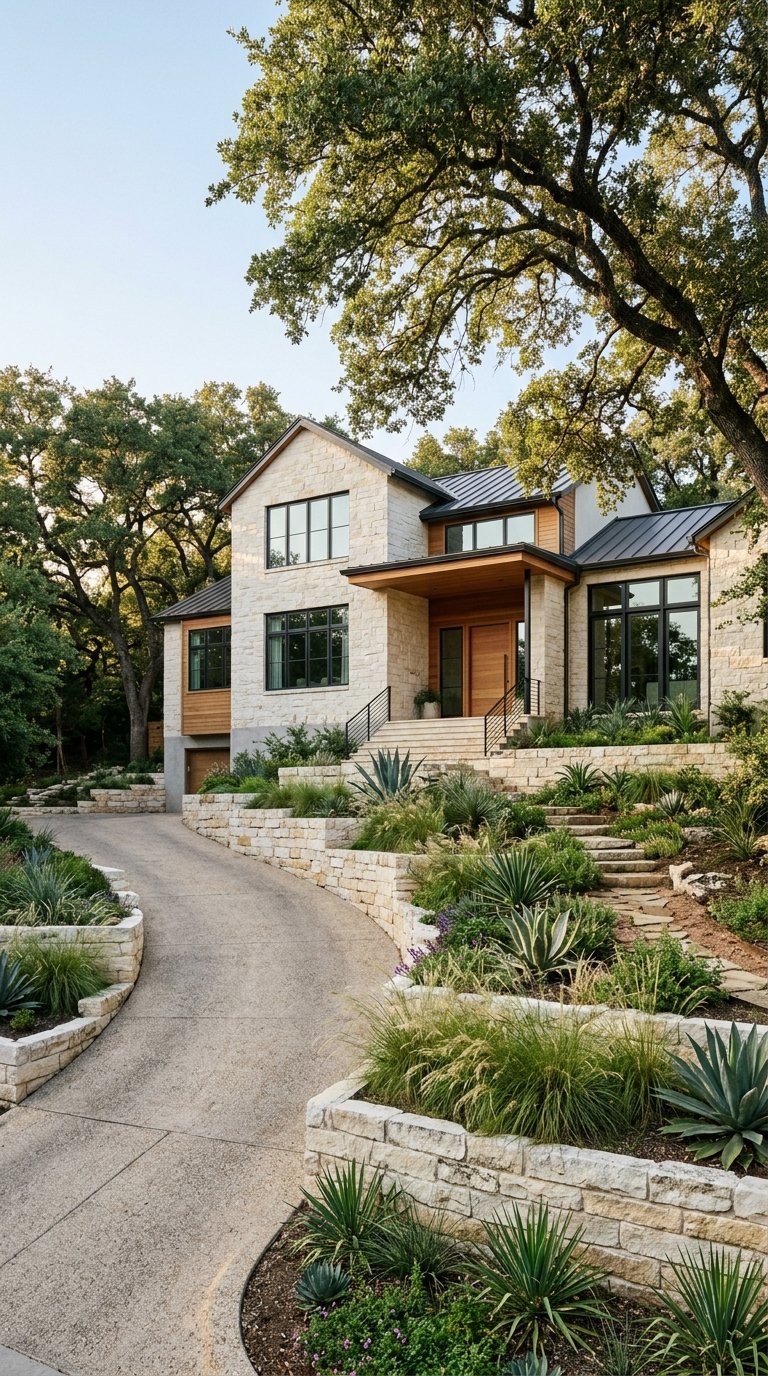
Northwest Hills benefits from Austin’s west-side terrain. The city becomes hillier west of MoPac, and that geography helps explain the rolling streets, terraced lots, and elevated settings that shape the neighborhood. The result is a part of Austin where topography is a major part of the value equation.
The upside is obvious. Local guides consistently point to Hill Country views, and buyers often place a premium on elevation, privacy, and site orientation. In the right location, a home can feel tucked away while still staying connected to major roads and daily needs.
The tradeoff is that slope affects usability. A steep driveway, a tiered backyard, or a hard-to-expand footprint can change how practical a home feels, even if the square footage looks strong on paper. Outdoor living areas, additions, and rebuild plans can all become more site-specific in this part of Austin.
That is why the best property is not always the biggest or newest. In Northwest Hills, many of the strongest homes combine usable lot area, attractive elevation, solid floor-plan function, and views that do not require excessive site work to enjoy. If you think about value through both lifestyle and resale, that combination tends to matter more than cosmetic upgrades alone.
Housing Styles You’ll See
Because much of the neighborhood developed over several decades, the streetscape is visually varied. You can expect a mix of ranch, mid-century, traditional, and newer custom homes. That variety gives buyers more choice, but it also makes pricing less straightforward.
In a newer subdivision with mostly similar homes, pricing often moves in tighter bands. In Northwest Hills, value can shift quickly based on the lot, the block, the remodel quality, and the way the home fits the site. That means you need to compare properties carefully instead of assuming every nearby sale is equally relevant.
For buyers who are open to renovation, this variety can create opportunity. An older home with a strong lot, good bones, and useful orientation may offer better long-term upside than a more polished property that has already maxed out its appeal. If you are willing to look beyond surface updates, Northwest Hills can reward that mindset.
What the Market Says About Value
Recent market data helps show why Northwest Hills stays on buyers’ radar. Redfin reports a median sale price of $757,500 in March 2026 for Northwest Hills, compared with $530,000 for Austin overall. That gap suggests buyers are willing to pay a premium for what this area offers.
The same data shows 62 median days on market and 26 sales for the neighborhood that month, compared with 58 days and 838 sales citywide. So while Northwest Hills is not a high-volume market, it still sees active demand. It also posted a 96.5% sale-to-list ratio, with 15.4% of homes selling above list.
Those numbers matter because they support what local buyer guides have been saying for years. This is a neighborhood where strong lots, usable space, privacy, and thoughtful positioning continue to attract buyers. Even when inventory is limited, well-positioned homes can still command attention.
How to Evaluate a Home Here
If you are shopping in Northwest Hills, it helps to think beyond standard online filters. Bedroom count and updated kitchens matter, but they are only part of the picture. In this neighborhood, the site often carries just as much weight as the finish level.
Here are a few things to study closely:
- Lot usability: How much of the yard is actually functional for play, pets, gardening, or outdoor living?
- Slope and access: Is the driveway easy to use daily, and does the site create hidden costs for future changes?
- Orientation: Does the home capture privacy or views in a meaningful way?
- Tree canopy: Mature trees add appeal, but they also shape light, outdoor use, and the feel of the lot.
- Floor-plan function: Does the layout work as-is, or would you need major changes to make the home live well?
- Restrictions: Are there subdivision-specific limitations or no HOA at all?
This is where a strategic approach can help. A house that looks average online may have excellent long-term potential if the lot is strong and the layout can be improved efficiently. On the other hand, a fully remodeled home may not always justify its premium if the site limits future flexibility.
Getting Around From Northwest Hills
Access is another part of the neighborhood’s appeal. The area is framed by major corridors including MoPac, US 183, Loop 360, and RM 2222. For many buyers, that makes Northwest Hills feel connected without being in the middle of the city’s busiest core.
Commute patterns here tend to be corridor-based. Many residents think in terms of MoPac southbound for central Austin, US 183 for north and northeast access, and surface streets like Mesa, Far West, Spicewood Springs, and RM 2222 for local circulation. That structure gives you multiple ways to move through the city depending on your routine.
Transit also plays a role. CapMetro’s 980 North MoPac Express serves northwest Austin and uses the MoPac Express Lanes to reach downtown. On the road side, the 183 North Mobility Project includes added express and general-purpose lanes along with direct connectors to MoPac, which reflects ongoing investment in regional mobility.
Who Northwest Hills Fits Best
Northwest Hills tends to appeal to buyers who want more land and elevation than central Austin typically offers. It can be a strong fit if you value privacy, mature trees, and a neighborhood where lot quality has a real impact on lifestyle and resale. It also makes sense if you want options, from original homes with upside to updated properties and custom replacements.
This is especially attractive if you like to think long term. Buyers who understand renovation potential, site value, and future positioning often see the neighborhood clearly. Instead of asking only whether a home looks finished today, they ask whether the property gives them room to create or preserve value over time.
That kind of lens matters in Northwest Hills because this is not a plug-and-play neighborhood in every case. It rewards careful evaluation. When you buy the right lot, on the right street, with the right plan, you are often buying more than a house. You are buying options.
If you’re considering Northwest Hills and want to look at homes through both a lifestyle and value lens, working with an advisor who understands renovation potential, lot quality, and long-term positioning can make the process much clearer. To talk through your goals, connect with Deep Parikh.
FAQs
Is Northwest Hills in Austin one big HOA neighborhood?
- No. The Northwest Austin Civic Association is a civic association, not an HOA, and neighborhood rules are not uniform across the full area.
Are Northwest Hills lots larger than many central Austin lots?
- Generally yes. Local buyer guides commonly describe lot sizes around 0.25 to 0.5 acres, with many properties offering quarter-acre-plus lots.
What gives Northwest Hills homes value in Austin?
- Lot usability, tree canopy, floor-plan function, privacy, and view orientation tend to matter more than cosmetic finishes alone.
Is Northwest Hills a good location for Austin commuting?
- It can be attractive for corridor access because the area connects to MoPac, US 183, Loop 360, RM 2222, and CapMetro Express service.
What types of homes are common in Northwest Hills?
- Buyers will typically see ranch, mid-century, traditional, remodeled older homes, and newer custom replacement homes.
Why do two Northwest Hills homes with similar size feel so different?
- Terrain, slope, lot shape, tree cover, and site orientation can change usability, privacy, expansion potential, and views even when square footage is similar.